You have already given up conventional cigarettes, but your vape never leaves your side. From morning to night, you take puff after puff of liquid nicotine; the very idea of quitting vaping with laser seems harder to you than putting out your last cigarette. You are not alone: this situation is common among long-term vapers who want to quit vaping with laser but cannot manage to take the plunge.
In this context, auricular laser therapy (or laser photobiomodulation) is sometimes presented as a gentle solution: a single, painless session to “cut off” the urge to vape. This promise is attractive, but it also raises many questions: how does the laser work? How does this withdrawal differ from conventional smoking cessation? What can you really expect from it?
The overview that follows aims to shed light on these points and to show how laser may, or may not, fit into a comprehensive plan for quitting vaping suited to your situation.
Vaping: how laser can help you quit vaping and break free from dependency on liquid nicotine.
Reading time: ~11 min
- Quitting vaping with laser: a different issue from cigarettes
- How auricular laser therapy works
- What we really know about the effectiveness of laser
- Laser, nicotine replacement, therapies: a comparison
- Who is laser for?
- How a session works
- The place of laser and the role of ABC Laser
- Frequently asked questions
- In summary
Quitting vaping with laser: a different issue from cigarettes

A dependency specific to vaping
Withdrawing from an e-cigarette is not simply a copy and paste of quitting smoked tobacco. Three factors often reinforce dependency: liquid nicotine can be highly concentrated and consumed without restriction all day long; the act of vaping is ritualised, associated with relaxation or stress management; finally, the image of a product considered “less dangerous” can lower vigilance and delay the decision to stop.
Perhaps you have already managed to quit smoking, but vaping has remained your crutch: the brain has created a new ritual, while nicotine continues to circulate, even if the risks differ from those of smoked tobacco. Quitting vaping therefore means acting at the same time on chemical dependency, habits and the fear of relapsing into conventional cigarettes.
How auricular laser therapy works according to its promoters
The principle of auricular laser therapy
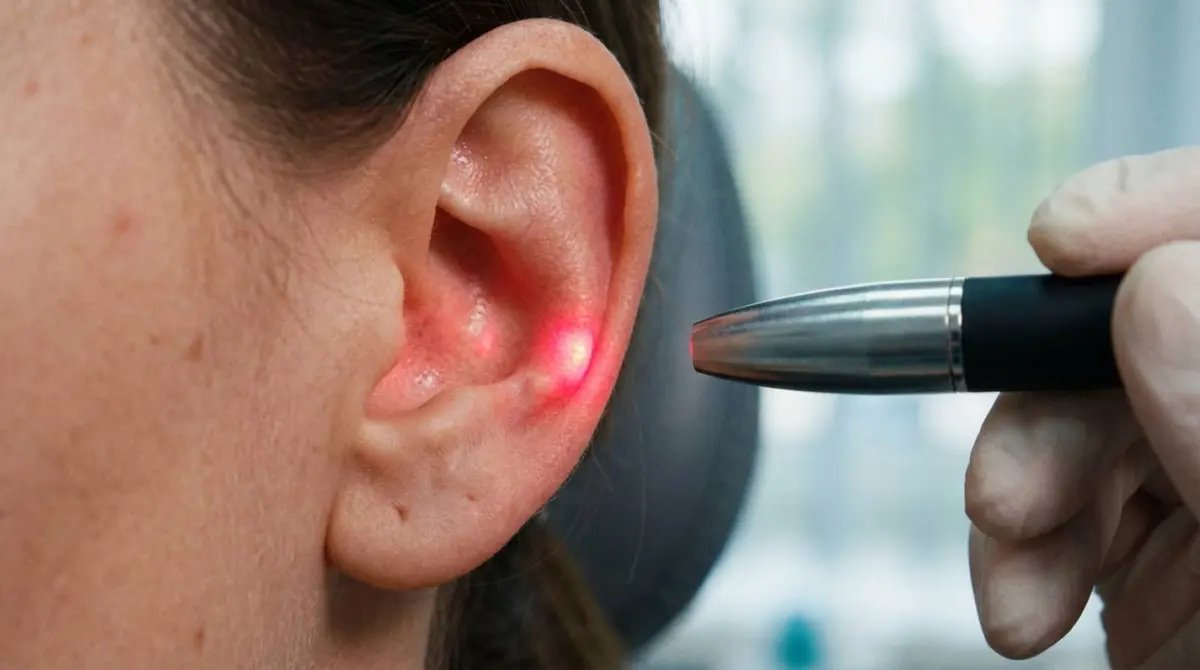
Inspired by auriculotherapy (ear acupuncture), the method replaces needles with a low-intensity cold laser applied to reflex points on the outer ear. Centres explaining this approach claim that the stimulation activates nerve circuits linked to the brain’s reward system: the release of endorphins and endogenous opiates that would “replace” the soothing effect of nicotine and ease cravings.
In practice, the session lasts about an hour, including twenty minutes of laser. The promoters highlight a painless session, a thorough preliminary questionnaire, post-treatment advice for managing risky situations and the possibility of a free retreatment in the event of relapse within the year. Presented in this way, the method seems appealing; but the available scientific data still needs to be examined.
What we really know about the effectiveness of anti-vaping laser
Scientific evidence that is still limited
Quality studies on laser applied to quitting smoking or vaping are rare and heterogeneous. To date, no solid evidence establishes greater effectiveness than a placebo or no treatment; the Haute Autorité de Santé stresses that it is impossible to conduct a reliable meta-analysis. A significant share of the results observed could be due to the placebo effect and the person’s motivation on the day of the session. Validated treatments (nicotine replacement, specific medications), on the other hand, have positive randomised trials.
In summary, laser does not replace approaches with proven effectiveness; it can be considered as a complement, provided you remain clear-sighted about its limits and are followed by a health professional.

Laser, nicotine replacement, behavioural therapies: a comparison at a glance
Who laser for quitting vaping may be suitable for
The typical profile is that of a former smoker who switched to e-cigarettes several years ago, consuming nicotine almost continuously, who has experienced several failed attempts to quit and fears relapsing into conventional cigarettes if they stop abruptly. In this context, the laser session can serve as a symbolic trigger: booking an appointment, filling in a detailed questionnaire, making a public commitment… all actions that strengthen motivation. Nevertheless, if you rely solely on the technology without changing your routines, disappointment lies in wait: laser does not remove automatic behaviours or the emotional context of vaping.
How a session to quit vaping with laser typically unfolds
- Initial interview (30 – 45 min): history of consumption, previous attempts, fears and motivations.
- Application of the laser (≈ 20 min) on different points of the ear, sometimes supplemented by a few additional reflex zones.
- Advice for the following days: stress management, substitute activities, adapting your environment, strategy for dealing with cravings.
After the session, some centres offer remote follow-up and a second session if needed. Cold laser causes neither burns nor pain, but the usual symptoms of nicotine withdrawal (irritability, hunger, reduced concentration) may persist, even if they are sometimes described as milder.
The place of laser in comprehensive support and the role of ABC Laser
ABC Laser’s services fall within wellbeing; they do not constitute a medical procedure and replace neither treatment nor health advice. The centre offers a supportive setting, time to listen and an additional supportive technique. The team systematically encourages consultation with the doctor, the smoking cessation specialist or the public health nurse, particularly if there is a medical history or ongoing treatment.
This support can be combined with validated approaches (nicotine replacement, medication), psychological care (cognitive behavioural therapy) or a plan to gradually reduce nicotine and the frequency of vaping. The laser session can thus help you feel ready and supported, but the key remains the lasting transformation of habits.
Frequently asked questions about laser and quitting vaping
Is laser really effective?
Current scientific data do not show greater effectiveness than a placebo. Some people feel rapid relief, others do not; it is therefore wiser to consider laser as a tool complementary to an overall quitting plan.
How many sessions are needed?
Most centres offer a single session with a free retreatment in the event of relapse. In practice, many vapers supplement this approach with medication or psychological support to stabilise the result.
Are there any risks or side effects?
Cold laser has not been associated with burns or pain. On the other hand, the usual symptoms of nicotine withdrawal may occur: irritability, hunger pangs, reduced concentration, sometimes milder after the session.
Is laser enough if I vape with a high nicotine strength?
The higher the dependency, the more a combination of several approaches is advisable. Medical advice will make it possible to adapt the strategy (nicotine replacement, medication) rather than relying solely on laser.
What if I vape without nicotine?
The dependency is then essentially behavioural. Laser does not act directly on the gesture; support focused on habits will often be more decisive, even if the session can mark a symbolic starting point.

In summary, for truly lasting quitting of vaping
Presented as gentle and non-invasive, auricular laser therapy aims to reduce cravings for liquid nicotine and make quitting vaping easier. However, its effectiveness has not been solidly demonstrated; it replaces neither validated treatments nor medical follow-up. The safest course is to build an overall plan that takes into account your level of dependency, your fears and your habits, combining recognised withdrawal tools. To find out how laser can fit into such a plan, you can look at the solutions offered on the ABC Laser website and discuss them with your health professional.