1 hour, 24 hours, 1 year smoke-free: the timeline of benefits for your body after the laser session – benefits of quitting smoking timeline.
Reading time: ~12 min
- Why the benefits of quitting smoking follow a precise timeline
- 1 hour smoke-free: what happens just after your laser session
- From 2 days to 1 month: the first changes
- From 3 months to 1 year: the lasting benefits
- Quick guide to the benefits over time
- The role of laser in this timeline of benefits
- Mini FAQ on the benefits after quitting smoking
Why the benefits of quitting smoking follow a precise timeline
When you stub out your last cigarette, your body immediately starts a repair programme. This programme follows a fairly consistent timeline for most people, because the mechanisms involved (carbon monoxide, nicotine, inflammation, blood circulation) are well known.
– Nicotine leaves your body in about 48 hours, which explains the physical withdrawal phase at the very beginning.
– Carbon monoxide disappears in less than 24 hours, leaving oxygen free to circulate.
– The airways, blood vessels and tissues need a few weeks to a few months to recover.
– The risk of serious diseases (heart attack, stroke, cancers) decreases gradually, over several years.
The method used to stop does not change these biological timescales. However, a laser session (laser auriculotherapy) can help you cope better with withdrawal symptoms, in particular by stimulating the production of endorphins and serotonin: you feel calmer, less irritable, with less overwhelming urges to smoke.
The services offered by ABC Laser are complementary wellbeing support. They do not constitute a medical procedure, do not replace treatment or medical advice and in no way replace follow-up by a health professional.
1 hour smoke-free: what happens just after your laser session

From 20 minutes to 8 hours: the very first positive reactions
Twenty minutes after your last cigarette, your blood pressure and heart rate return towards normal values. Your blood circulation relaxes, which already improves the oxygenation of your organs.
In the hours that follow, around 8 hours, the level of carbon monoxide in your blood is halved; oxygen regains space on your red blood cells, and your organs are better supplied. If you have had an anti-smoking laser session, this phase is often calmer than expected thanks to the stimulation of the auricular points: relaxation increases and the compelling urge to light up another cigarette decreases.
From 8 hours to 24 hours: your body cleans itself out thoroughly
From 24 hours without tobacco, the carbon monoxide is practically eliminated, the lungs begin to expel mucus and the risk of heart attack is already decreasing. You may feel your breathing is smoother and your energy higher. The first withdrawal symptoms (irritability, difficulty concentrating, fatigue) often appear here; laser stimulation, by encouraging the production of endorphins, tends to make this milestone more bearable.
From 2 days to 1 month: the first changes
48 to 72 hours: taste, smell and breathing change
After 48 hours, the nicotine is eliminated; taste and smell improve markedly. Around 72 hours, the airways dilate, breathing becomes easier and energy picks up. This is a pivotal moment when cravings can be felt more strongly; the relaxing effect of the laser often helps to limit irritability and tension.
From 2 to 12 weeks: less breathlessness, more stamina
Between 2 and 12 weeks, blood circulation improves, breathlessness decreases, the morning cough subsides and your complexion looks fresher thanks to better oxygenation of the skin.

Up to 1 month: a clearer mind and a body that repairs itself
After one month, concentration, anxiety and sleep improve for most people. The skin heals better. Occasional urges to smoke still exist but are less intense; laser stimulation of the points linked to stress can help consolidate your new smoke-free routine.
From 3 months to 1 year: the lasting benefits
From 3 to 9 months: your lungs regenerate
After 3 to 9 months, lung capacity can increase by around 10%. Episodes of coughing, wheezing and respiratory infections become rarer; physical exertion becomes more pleasant.
At 1 year and beyond: the risk of disease drops
After 1 year, the risk of heart attack is halved and the risk of stroke approaches that of a non-smoker. Fertility improves for everyone; erectile problems often decrease in men. At around 10 years smoke-free, the risk of lung cancer is halved.
Quick guide to the benefits over time
The role of laser in this timeline of benefits
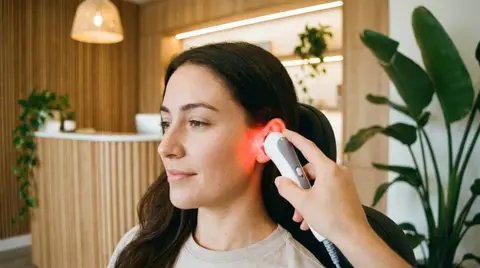
Anti-smoking laser auriculotherapy consists of stimulating, with a gentle and painless beam, points located on the ear linked to stress management, dependence and the feeling of craving.
- A relaxing effect that helps lower the anxiety associated with withdrawal.
- A reduction in the intensity of cravings (sudden urges to smoke).
- Greater comfort during the first few days, when withdrawal symptoms are usually at their strongest.
Studies do not currently provide proof that laser is more effective than any other method for stopping smoking; however, many centres and clients report a gentler, less anxiety-inducing withdrawal experience, which can make the difference in keeping it up over time.
Important: laser sessions fall within wellbeing and support, not a medical procedure. They replace neither follow-up by a health professional nor a prescribed treatment. They can, however, be part of an overall strategy to stop smoking.

Mini FAQ on the benefits after quitting smoking
Are the benefits really the same with or without laser?
Yes. Whether you stop on your own, with nicotine replacement, hypnosis or laser, the body's repair mechanisms are identical. Laser acts mainly on the comfort of withdrawal.
How long before I feel better in my breathing?
A first improvement can be felt after 72 hours. The improvement becomes clear between 2 and 12 weeks and even more marked between 3 and 9 months, when lung capacity increases.
Is it normal to feel more tired at the beginning?
Yes. The body is readjusting to the absence of nicotine, a former stimulant. This fatigue generally lasts from a few days to a few weeks and does not prevent the benefits from building up at the same time.
If I relapse, are all the benefits lost?
No. The smoke-free periods have already allowed your body to rest and repair some of the damage. Going back to cigarettes does, however, reactivate the risks. Each attempt is an experience that brings you closer to success; do not hesitate to get support.
Remembering this timeline is a powerful source of motivation. In 20 minutes, 24 hours, a few weeks and then 1 year, your body recovers at an impressive speed. Laser replaces neither the decision to stop nor medical follow-up; it can, however, make this journey gentler, especially during the first few days. To find out more, discover ABC Laser's approach on the official website and look forward calmly to your first smoke-free day.