What is the link between the auricular laser, acupuncture and traditional Chinese medicine? This question often comes up among people discovering laser ear stimulation to support a change in habits: stopping smoking, reducing sugar cravings, snacking or managing stress. To answer it, three things need to be distinguished: the history of the practices, the stimulation technique and what studies actually allow us to conclude. In Strasbourg, the ABC Laser® centre draws on this history to offer non-medical support, in particular to people coming from Haguenau and the Bas-Rhin.
Auricular laser and Chinese medicine: origins, how it works and support for habits in Strasbourg
Estimated reading time: 10 minutes
Contents
- What is the link between the laser and Chinese medicine?
- How did auriculotherapy develop?
- How does laser auricular stimulation work?
- Why is the auricular laser associated with tobacco and addictive habits?
- What is the link with sugar cravings and snacking?
- How does the support at ABC Laser Strasbourg work?
- Where can you discover this method from Strasbourg or Haguenau?
- What do scientific studies say about auriculotherapy?
- FAQ: auricular laser, Chinese medicine and quitting
- In summary: tradition, technology and support
What is the link between the laser and Chinese medicine?
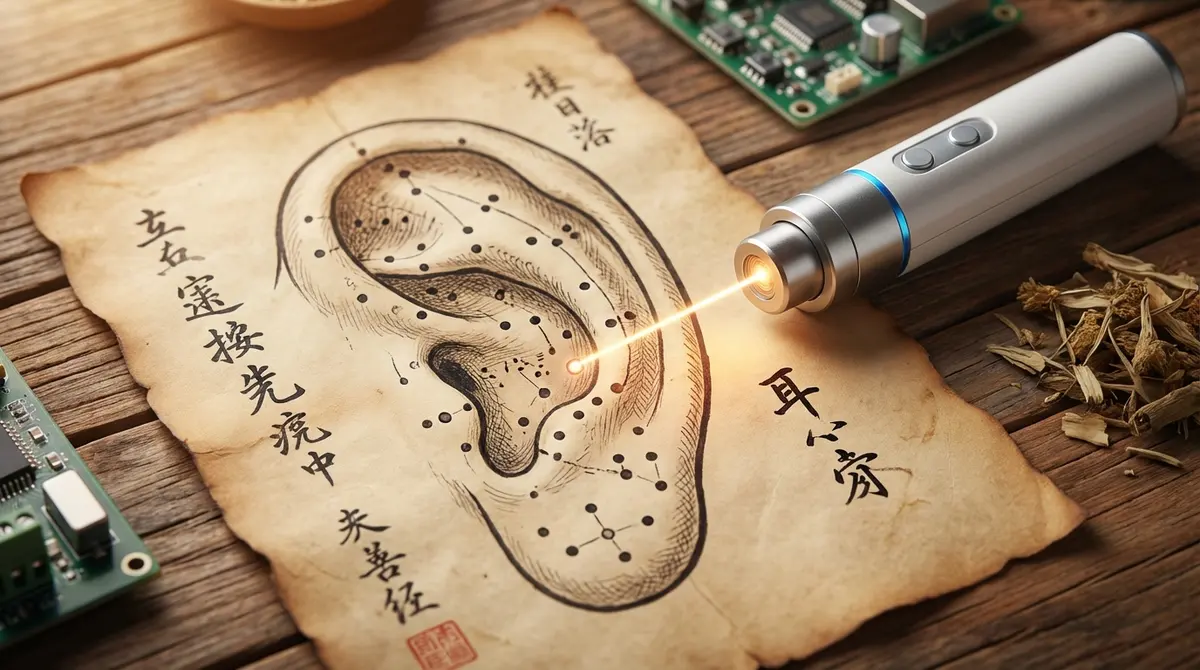
Meridians, acupuncture points and the notion of Qi
In traditional Chinese medicine, acupuncture is based on pathways called meridians and on the notion of Qi, often translated as “vital energy”. According to this traditional model, stimulating precise points aims to restore balance. This is a historical framework of thought: the existence of Qi and meridians as anatomical structures has not been established by modern scientific medicine.
Over time, stimulation techniques have evolved. Alongside needles, manual pressure, certain forms of electrostimulation and the use of low-power laser light have developed. This is sometimes referred to as laser acupuncture or gentle laser. However, the light technique should not be confused with proof of effectiveness for all the indications of acupuncture.
Chinese medicine and auricular reflexology: two histories that intersect
Ear stimulation exists in different traditions, but modern auriculotherapy also developed in France in the twentieth century. At ABC Laser, the method draws above all on this auricular approach: the points sought are located on the outer ear, and not along all the body meridians of classical acupuncture.
How did auriculotherapy develop?
Paul Nogier and the mapping of auricular points
In the 1950s, the French doctor Paul Nogier took part in formalising a map of the outer ear. In this representation, different areas of the ear are linked to regions or functions of the body. This correspondence is a principle of the method; it does not mean that each proposed link has been clinically demonstrated.
French and Chinese schools then helped to develop and compare their nomenclatures. The World Health Organization (WHO) carried out work to standardise the vocabulary and the points of auricular acupuncture. This work facilitates description and research, but does not constitute validation of the effectiveness of the laser against addictions.
Why talk about nerve pathways and reflex responses?
The ear has complex innervation, in particular through branches of several nerves. This particularity has encouraged research into the possible mechanisms of auricular stimulation. Neurophysiological hypotheses must still be distinguished from clinical results: observing a nerve response is not the same as proving that a session makes it possible to stop smoking or to eliminate a compulsive eating habit.
How does laser auricular stimulation work?
From the auricular point to low-intensity light
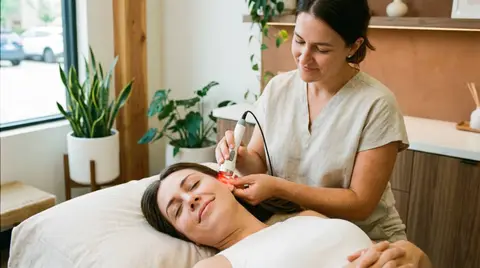
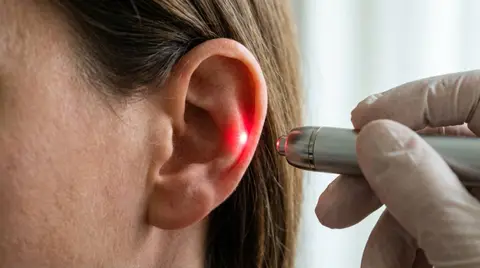
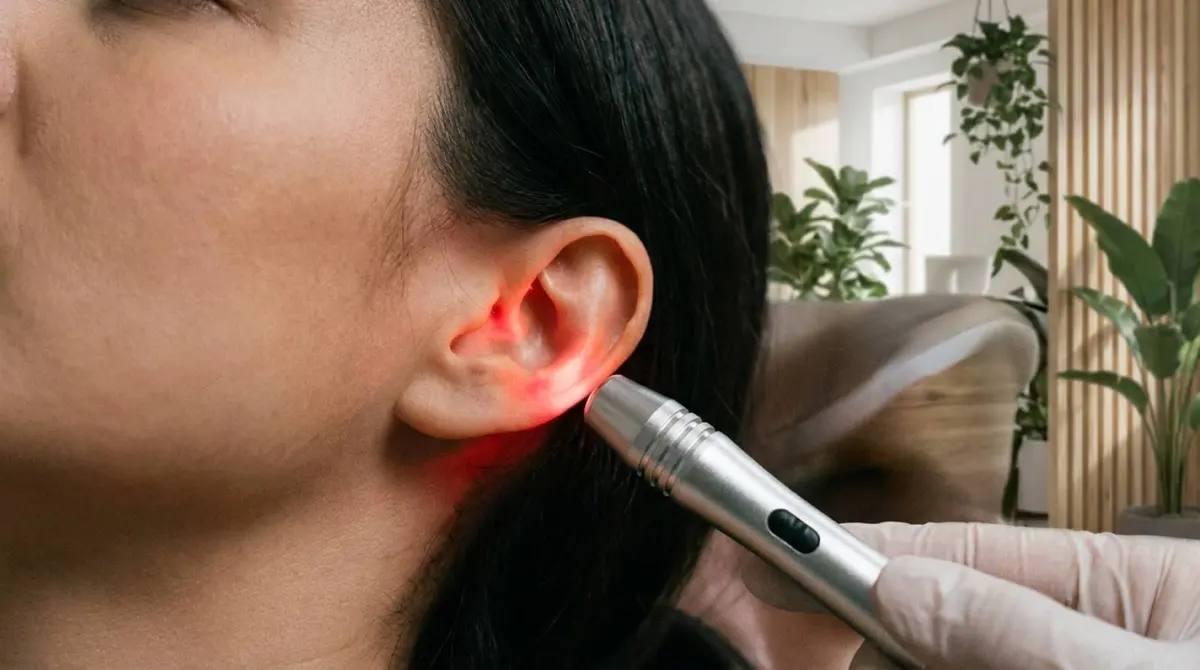
The auricular laser uses a light beam directed at precise areas of the ear, without piercing the skin. Unlike acupuncture with needles, this approach is non-invasive and generally described as comfortable. The terms photobiomodulation, laser auricular stimulation or laser auricular reflexology are also encountered. They are not perfectly interchangeable: photobiomodulation refers more broadly to the interaction of certain types of light with tissue, while auriculotherapy describes the choice of points on the ear.
In practice, the selection of areas, the equipment used and the application time depend on the practitioner’s protocol. The fact that a technique is needle-free does not mean that it is suitable for every situation; a prior conversation about your state of health and your treatments remains relevant.
What “stimulating a reflex point” means
In the language of auriculotherapy, stimulating a reflex point means applying stimulation to a specific area of the outer ear. Practitioners thus seek to support comfort and certain sensations during a process of change. No mechanism today makes it possible to state that a given point on its own extinguishes a nicotine dependence or a sugar craving.
Why is the auricular laser associated with tobacco and addictive habits?
Stopping smoking: distinguishing nicotine withdrawal from automatic habits
For a person who wishes to stop smoking, the difficulty may come from several factors: physical dependence on nicotine, cigarettes associated with coffee, a break at work, a car journey, stress or a social context. Cravings to smoke therefore cannot be reduced to a single mechanism.
At the ABC Laser centre in Strasbourg, auricular stimulation is offered as part of support for quitting smoking, combined with an interview about habits and practical advice. Follow-up and motivation are part of the support. To understand the service precisely, see our page stop-smoking laser in Strasbourg.
Important point: the laser is not a method whose specific effectiveness for stopping smoking has been scientifically demonstrated. It does not replace validated aids, in particular nicotine substitutes, support from a smoking cessation specialist and behavioural approaches. You can consult the information from Tabac info service.
Vaping, cannabis, alcohol: situations that call for different precautions
People with questions about vaping, cannabis or other forms of consumption sometimes face the same questions: how to cope with a sudden craving, break a ritual, manage tension or avoid starting again? Support for habits can be discussed, but not all dependencies should be put on the same level. Significant alcohol withdrawal may require medical care; stopping abruptly can be dangerous for a physically dependent person.
This distinction is essential: ABC Laser offers a wellbeing service, not a treatment for addictions. In the event of significant dependence, withdrawal symptoms or repeated difficulties, a doctor or an addiction professional is the appropriate person to consult.
What is the link with sugar cravings, hunger pangs and snacking?
Sweet cravings are not always linked to hunger
A craving for chocolate at the end of the day, sugar cravings after a period of stress, snacking in front of a screen, a need for comfort or irregular meals: these behaviours can be influenced by emotions, habits and the food environment. The expression “sugar addiction” is frequently searched for, but it does not, on its own, correspond to an established medical diagnosis for all sugar consumption behaviours.
At ABC Laser, the formule ÉQUILIBRE is intended for people who wish to work on their eating habits, their compulsive sugar cravings or snacking. The stated aim is to support a personal process of rebalancing, without promising that auricular stimulation treats an eating disorder or leads to weight loss.
To discover this approach, see our page devoted to sugar cravings, hunger pangs and snacking in Strasbourg.
Why adapt the support to each person’s behaviour?
A person drawn to desserts after dinner does not necessarily have the same need as someone else who snacks at work under the effect of stress. Before any process, it is useful to identify the times, the triggers, the sleep habits and the moments when cravings become difficult to manage. This behavioural analysis helps to define realistic goals, independently of the laser technique.
In the event of frequent compulsive eating, a marked loss of control, diabetes or diagnosed eating disorders, an appropriate medical, dietary or psychological assessment is the priority.
How does the support at ABC Laser Strasbourg work?
The approach offered at the centre is organised around several stages that make it possible to take into account the reason for the visit and the person’s habits.
- Initial conversation: understanding your goal, your previous attempts and the situations that trigger an urge to smoke or to snack.
- Locating the ear areas: selecting the points used in the centre’s personalised protocol.
- Targeted stimulation: depending on the protocol, a preliminary auricular stimulation may be followed by the application of the low-intensity laser, without needles.
- Advice after the session: planning for risky situations, adapting certain routines and determining, if necessary, the follow-up arrangements.
The protocol is presented as wellbeing support. How it feels varies from person to person and no duration of success, absence of relapse or effectiveness on an addiction can be guaranteed.
Where can you discover this method from Strasbourg or Haguenau?
In Strasbourg: a centre dedicated to support for habits
The ABC Laser® Strasbourg centre, located in the Hautepierre area, welcomes people interested in laser auricular stimulation as part of a plan to stop smoking, reduce sugar cravings or improve their wellbeing. Information about the services and appointment arrangements is available on the ABC Laser Strasbourg centre website.
From Haguenau: understanding the method before travelling
Do you live in Haguenau, Bischwiller, Brumath or in the north of the Bas-Rhin? Before choosing a form of support, take the time to compare how it works, its limits and the follow-up options. For a specific request, we have already devoted dedicated pages to support for stopping smoking near Haguenau and to sugar cravings for residents of the Haguenau area.
This local content makes it possible to explore each goal in more depth without confusing the origin of the method with the practical arrangements of a session.
What do scientific studies say about auriculotherapy and the laser?
Recognition of a nomenclature and proof of effectiveness: what is the difference?
The WHO’s historical work helped to define a common terminology for auricular points. However, standardising the points is neither a general authorisation of treatment nor proof that a method works against tobacco, sugar or other addictions.
In its evaluation report on auriculotherapy (2013), Inserm points out that the proposed physiological mechanisms remain poorly supported and that the available evidence does not allow a firm conclusion of effectiveness for the indications studied. For stopping smoking, Tabac info service points out that auriculotherapy and the laser are not among the scientifically validated methods.
What benefits can reasonably be expected from support?
For some people, a session can represent a time of listening and a concrete reference point in their decision to change their habits. However, this does not make it possible to attribute any improvement to the laser itself. For nicotine withdrawal, recognised aids and professional follow-up retain their full place; for persistent eating difficulties, nutritional or psychological support may be necessary.
| Question | Key points |
|---|---|
| Origin | Modern auriculotherapy draws on several traditions, including the French work of Paul Nogier. |
| Technique | The low-power laser stimulates areas of the ear without needles. |
| Tobacco and sugar | Support for habits can be offered, with no guarantee of specific effectiveness of the laser. |
| Health | The process does not replace treatments, medical advice or care for an addiction. |
FAQ: auricular laser, Chinese medicine and quitting
Is the auricular laser the same thing as Chinese acupuncture?
No. Traditional acupuncture uses needles on different points of the body, according to a historical model of meridians. The auricular laser uses low-power light on areas of the ear, within a framework inspired by auriculotherapy. The two approaches may share references, but they are not identical.
Can the laser replace patches to stop smoking?
No. The laser has not been shown to be able to replace nicotine replacement or validated support. If you are dependent on nicotine, ask a health professional to help you choose a suitable strategy.
Can this approach be used for sugar cravings or emotional snacking?
ABC Laser Strasbourg offers wellbeing support focused on eating habits. It is not a validated treatment for compulsive eating. Goals must remain personalised, and specialised care is necessary when the difficulties are significant.
Is the auricular laser painful?
The light stimulation is carried out without needles and is generally described as comfortable. How it feels can vary. Always mention your medical history, treatments and any particular situation before the session.
Does the WHO recognise the stop-smoking laser as a treatment?
No. The work on standardising acupuncture and auriculotherapy points does not mean that the WHO recognises the laser as an effective treatment for smoking.
Where can I find auricular laser support near Haguenau?
Residents of Haguenau and the surrounding area can consult the information from the ABC Laser Strasbourg centre and the pages dedicated to tobacco or sugar before getting in touch. The session location and availability should be confirmed directly with the centre.
In summary: between Chinese medicine, auriculotherapy and laser technology
The link between laser and Chinese medicine is above all historical and technical: traditions of point stimulation, the development of auriculotherapy in France and the later use of low-intensity laser light. This lineage does not, on its own, demonstrate effectiveness in stopping smoking or controlling sugar cravings.
If you are looking for a personalised process to work on your habits, ABC Laser® offers in Strasbourg laser auricular stimulation combined with a conversation and advice. Do you live in Strasbourg, Haguenau or northern Alsace? Discover our services, find out about their limits and contact ABC Laser Strasbourg to talk about your goal, with no obligation.
Documentary sources: Inserm, evaluation of auriculotherapy (2013); Tabac info service, auriculotherapy and stopping smoking; WHO, standardisation of acupuncture nomenclature (1990).