
Do you feel you are no longer in control of your sugar cravings? Simply thinking about a dessert sometimes triggers an urge that is hard to curb. It is not just a question of willpower: sugar and dopamine form a powerful chemical duo that gradually short-circuits your internal satiety signals.
In this article, we will see how sucrose activates the same circuits as certain illicit substances and why the cold light of laser, inspired by acupuncture, can help rebalance these mechanisms. The aim: to understand the role of dopamine, the limits of “sugar as pleasure” and the ways to regain control over your eating behaviour.
Dopamine and sugar: how laser reprogrammes the reward circuit
Reading time: ~9 min
Contents
- Sugar and dopamine: what really happens in your brain
- When sucrose behaves like a substance
- Cold light and reflex points: how laser acts on the reward circuit
- Sugar and dopamine: what a laser session actually changes
- Limits, precautions and the importance of all-round support
- Mini FAQ on sugar, dopamine and laser
Sugar and dopamine: what really happens in your brain
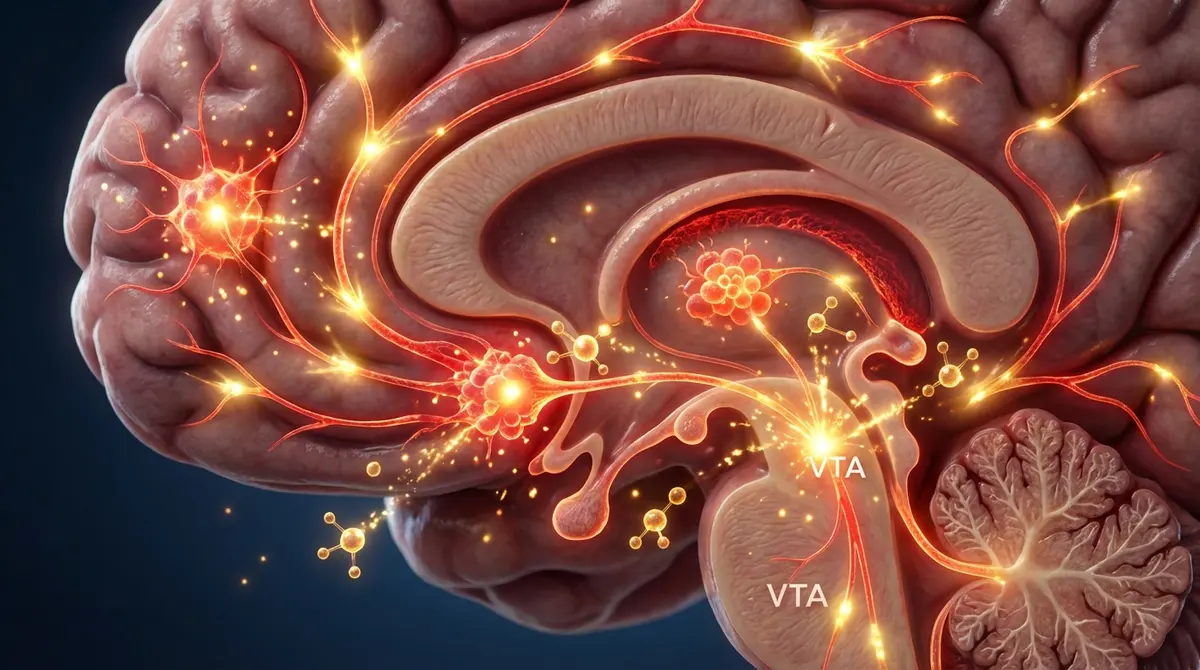
The role of dopamine in the reward circuit
With every sweet mouthful, a neural cascade is set off. The sweet taste receptors on the tongue send a signal to the ventral tegmental area and the nucleus accumbens, pillars of the reward circuit designed to push us to repeat behaviours useful for survival.
When sugar tolerance sets in
The central player is dopamine, the neurotransmitter of motivation and learning. Research shows that a very sugary food can raise dopamine in the striatum by 135 to 140%, levels comparable to those observed with nicotine or alcohol; substances, for their part, reach around 500%.
With repetition, dopamine receptors become less sensitive; the same amount of sugar provides less satisfaction, prompting larger or more frequent portions. This vicious circle resembles a behavioural addiction, although the mechanism depends on repetition, emotional context and individual vulnerability.
When sucrose behaves like a substance
Mechanisms similar to those of substances
At the neurobiological level, sugar, nicotine, alcohol, cocaine or cannabis all converge on the same reward regions. Repetition creates a form of tolerance: the more frequent the intake, the more the brain adapts, leading to greater or more automatic consumption.
When sugar becomes a self-soothing strategy
Sugar, however, causes neither acute intoxication nor a life-threatening withdrawal syndrome like alcohol or certain opioids. It is therefore more accurate to speak of compulsive eating behaviour than of severe addiction. Chronic stress and high cortisol often drive the brain to seek this quick comfort: sucrose becomes a self-soothing strategy.
Cold light and reflex points: how laser acts on the reward circuit
Stimulation inspired by auriculotherapy
Gentle laser therapy is inspired by auriculotherapy: the ear is considered a reflex map of the body. A very low-intensity, painless light beam is applied to auricular points linked to the brain areas of reward and stress.
The main intended effects
- An increase in endorphins and enkephalins that compensate for the drop in dopamine when cutting down on sugar.
- Modulation of the autonomic nervous system: lower cortisol and fewer stress-driven automatic eating habits.
- Gradual rebalancing of the reward circuit by breaking the association “I feel bad; I need sugar right now”.
The method, practised in specialist centres, is accompanied by a conversation about eating habits and triggers. To find out more, consult the page dedicated to the natural laser technique for sugar detox.
Sugar and dopamine: what a laser session actually changes
Changing the brain’s response to sugar
Applied to sugar compulsions, laser stimulation seeks to change the brain’s response to sugar-related signals.
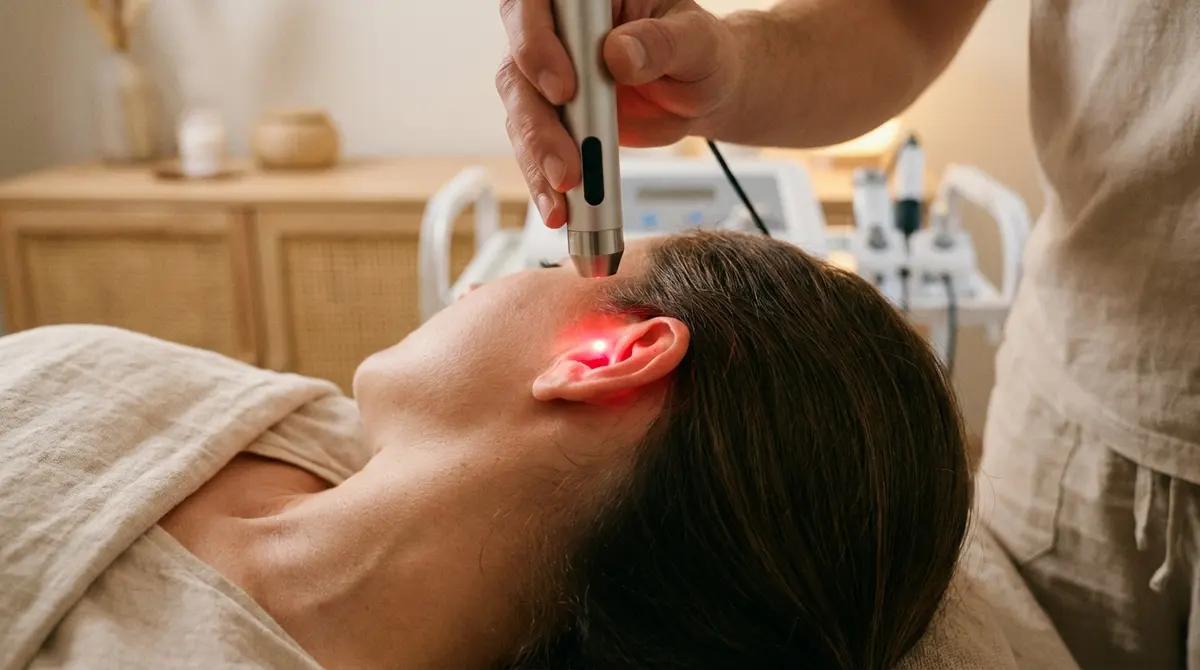
Effects felt after a session
- A rapid reduction in intense cravings; some people feel the urges almost disappear within a few hours or days.
- A feeling of calm and of being refocused thanks to the action on the autonomic nervous system.
- Improved sleep and stress levels by replacing sugar as an emotional regulator.
- A more neutral relationship with food: sugar becomes just one food among others again.
A window for changing your habits
Stimulation of the reflex points acts on the hypothalamic-pituitary axis, the hormonal conductor linked to the hunger, satiety and reward systems. It does not rule out work on diet and emotions; rather, it offers a “window” in which compulsions are less strong. More details are available on the regulating sugar consumption page.
Limits, precautions and the importance of all-round support
A complementary approach
The analogy with substances helps to understand the impact of sugar on dopamine, but not everyone becomes “addicted” to sugar as they would to heroin. Laser therapy remains complementary; randomised studies specific to sugar are still limited.
When professional follow-up is necessary
Laser must not be presented as a miracle solution; your involvement and all-round support are essential. In the case of a confirmed eating disorder (bulimia, binge eating disorder, restrictive anorexia with episodes of bingeing), psychological or psychiatric follow-up is essential. If you are diabetic or have a chronic condition, discuss any dietary change with your doctor.
ABC Laser’s services fall within wellbeing, do not constitute a medical procedure and do not replace follow-up by a health professional. For broader work, the centre offers a balance package focused on stopping sugar and weight management.
Mini FAQ on sugar, dopamine and laser
Is sugar really a substance for the brain?
Sugar does activate the reward circuit and raises dopamine to levels comparable to nicotine or alcohol. Its impact nevertheless remains lower than that of substances, and not everyone develops an addiction; it is more accurate to speak of compulsive eating behaviour in sensitive people.
Why is it so hard to cut down on sugar even when you are motivated?
The brain has memorised sugar as a shortcut to relief and pleasure. The drop in dopamine when intake is reduced is perceived as a lack; without a strategy to compensate for this drop (endorphins, stress management), willpower alone is rarely enough.
How can laser reduce sugar cravings?
By stimulating reflex points linked to the central nervous system, the cold light of the laser encourages the release of endorphins and modulates dopamine production. This combination calms the autonomic nervous system and eases the feeling of craving.
Is a single session enough to reprogramme my reward circuit?
Some people feel an improvement after a single session, others need a booster. Effectiveness increases when it is combined with concrete changes in diet and lifestyle.
Does laser replace medical or nutritional follow-up?
No. Laser stimulation is part of a complementary wellbeing approach; it replaces neither medical diagnosis, nor treatment, nor nutritional or psychological follow-up, but can make these steps easier by reducing compulsions.

Conclusion: rebalancing the sugar and dopamine duo
Understanding the link between sugar and dopamine shows that your repeated cravings are not simply a lack of willpower but a reward circuit that is constantly being stimulated. The cold light of the laser, inherited from auricular acupuncture, offers a gentle method to rebalance this circuit. To explore this approach and regain control of your sugar cravings, you can discover our solutions.