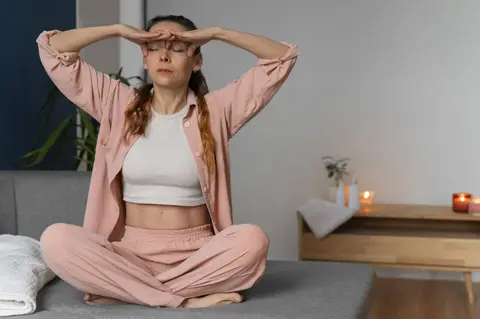
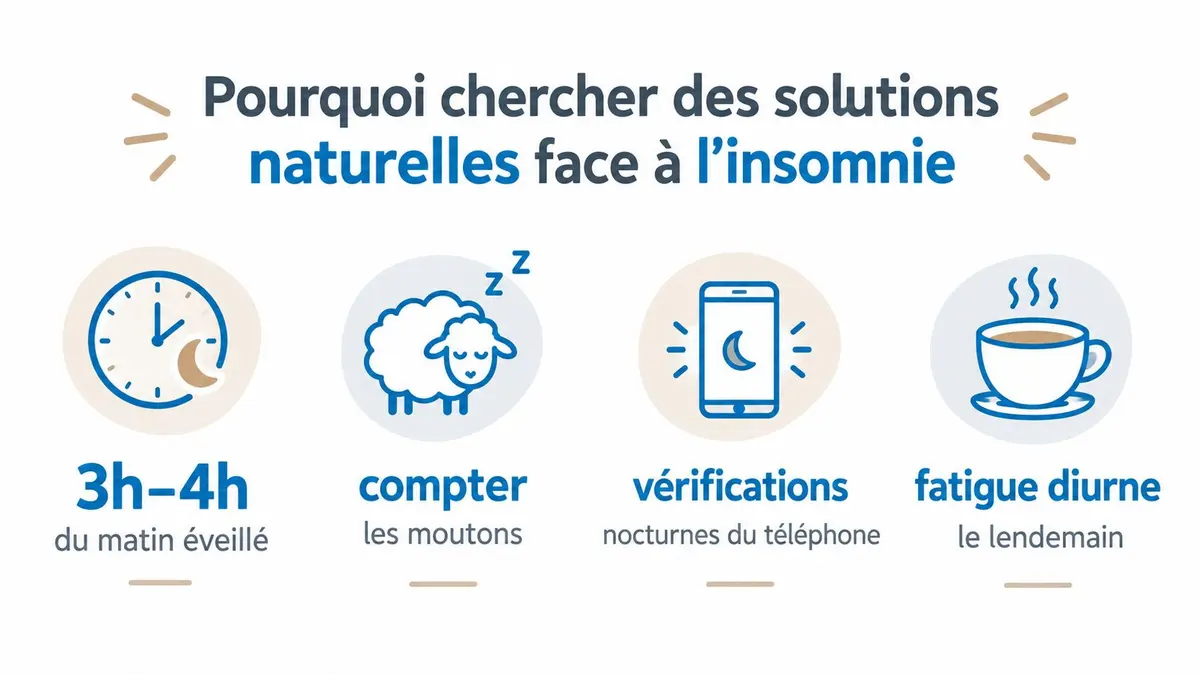
3 o’clock in the morning, your mind replays the day, you count sheep, then you check your phone hoping to find a solution there. The next day, the alarm goes off and you get up with that feeling of never having really recovered. The following evening, the apprehension returns even before you go to bed.
This situation is not marginal. In France, the data from Santé publique France on sleep indicate that in 2024 the average sleep duration reported by adults aged 18 to 79 was 7 h 32, while 21.5 % were classed as “short sleepers”, with 6 hours or less of sleep. A third of adults also reported a complaint of insomnia, peaking at 43.4 % among women aged 70 to 79.
Table of contents
- Why look for natural solutions to insomnia
- Natural does not mean risk-free
- Building your sleep hygiene protocol
- Correcting the most common disruptors
- Adapting the routine to your profile
- Herbal medicine and supplements: what evidence for which insomnia
- Choosing according to the goal
- Relaxation techniques you can apply immediately
- 4-7-8 breathing
- Cardiac coherence
- Progressive muscle relaxation
- Photobiomodulation and auricular reflexology for sleep
- An option to place within the hierarchy
- When to move from self-help to professional support
- Making the right choice at the right time
Why look for natural solutions to insomnia
You have been having trouble falling asleep for a few evenings, or you wake up every night with your mind already on alert. Before multiplying herbal teas, apps and supplements, you need to determine what is really keeping your difficult nights going. Looking for a natural solution to insomnia means acting on the modifiable factors, while keeping a realistic assessment of the situation.
In my practice, I first distinguish three profiles. For difficulty falling asleep, the work focuses mainly on the transition between activity and rest. For night-time waking, you need to examine the sleep rhythm, physical factors and the reaction on waking. For evening anxiety, the priority is to reduce anticipation and the monitoring of sleep. A person who already dreads the following day does not need the same protocol as a person whose schedule is out of sync.
The first useful decision is therefore to identify the dominant scenario.
Natural does not mean risk-free
A plant can interact with a treatment, and a supplement may not suit your state of health. A relaxation technique also loses its value if you practise it with the obligation to fall asleep immediately. These approaches require regularity, simple observation of the results and gradual adjustments. They can support sleep, but they are not an instant solution.
Persistent problems deserve structured attention. Historical data from Santé publique France on insomnia reported a prevalence of chronic insomnia of 13.1 % among 18-75-year-olds, including 16.9 % among women and 9.1 % among men. These figures do not determine the cause of an individual’s insomnia, but they show that a lasting difficulty should not be reduced to a simple lack of willpower.
Practical rule: test one method at a time, observe how you fall asleep, your night-time waking and how you feel in the morning, then decide whether or not to keep it.
Self-help is suitable when the problems remain occasional, with no worrying symptoms, and the changes remain manageable. Seek professional advice if difficult nights become established, if anxiety increases or if you suspect another sleep disorder. A centre such as ABC LASER in Strasbourg can then offer auricular laser support as a complementary option, without replacing the necessary medical advice.
Building your sleep hygiene protocol
Sleep hygiene works when it becomes a personalised protocol, not an endless list of prohibitions. Start by observing your usual week. Note the time you go to bed, the approximate time needed to fall asleep, night-time waking, coffee consumption, screen exposure and your level of tension in the evening.
Correcting the most common disruptors
The most frequent mistakes are easy to spot. Screens keep your attention in an active mode, irregular hours blur your reference points and a bedroom that is too warm makes the transition to sleep less comfortable. Caffeine consumed late can also maintain an alertness that you then wrongly attribute to anxiety.
Organise your environment in practical terms:
- Light and screens. Keep screens away from the period before bedtime. If you have to keep your phone near you, turn off notifications and put it out of immediate reach.
- Temperature. A slightly cool bedroom is generally more favourable than an overheated room. Air the room before going to bed and adapt your bedding rather than maintaining excessive heat.
- Schedule. Keep your wake-up time as stable as possible, including after a bad night. Sleeping in very late to compensate can make falling asleep the next time more difficult.
- Caffeine. If you are sensitive to coffee, tea or energy drinks, move your consumption to the morning and observe how your nights change.
Adapting the routine to your profile
For difficulty falling asleep, the routine should gradually reduce activation. Gentle muscle relaxation, light reading and preparing the next day’s tasks can prevent your bed from becoming the place where you mentally organise your whole day. For night-time waking, avoid repeatedly checking the time. For evening anxiety, write down your worries and the next possible action before entering the bedroom.
Type of insomnia Main sign Priority action Expected time to effect Difficulty falling asleep The mind stays active at bedtime Reduce stimulation and set up a repetitive routine Gradual, with regular practice Night-time waking Waking followed by a long period of wakefulness Do not check the time, limit light and return to calm Variable depending on the cause of waking Evening anxiety Anticipatory thoughts and bodily tension Preparatory writing, breathing and muscle relaxation Often noticeable during practice, gradual consolidation Irregular rhythm Shifted sleep and changing schedules Above all, stabilise wake-up time and exposure to morning light Gradual, to be assessed over several days Do not try to apply all the recommendations tonight. Choose one environmental correction and one routine, then give them enough continuity to distinguish a real effect from a simple natural variation in your nights.
Herbal medicine and supplements: what evidence for which insomnia
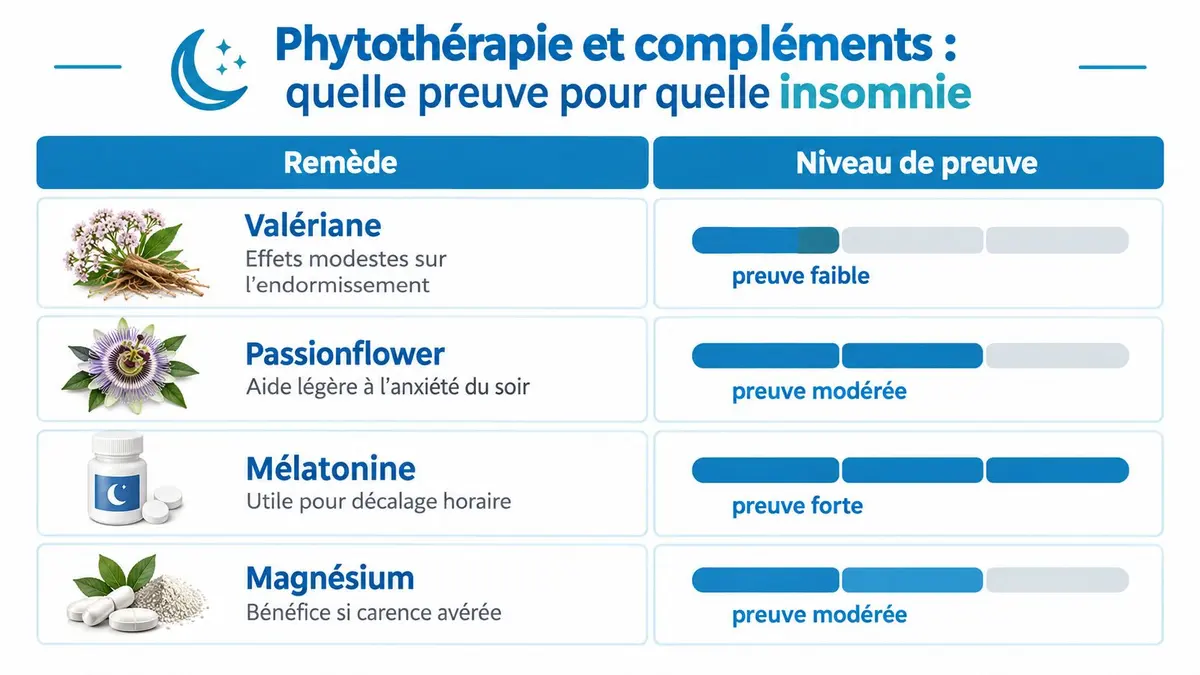
Plants and supplements are attractive because they seem easy to incorporate. Yet their value depends on the insomnia profile, the quality of the product, any treatments already being taken and the cause of the problem. The French medical information gathered by VIDAL on solutions for insomnia points out that the effectiveness of plants and of certain melatonin-based products is variable or insufficiently demonstrated depending on the situation.
For mild difficulty falling asleep, valerian or lemon balm can be considered as occasional support, with modest expectations. They do not automatically correct a shifted rhythm, a sleep debt, significant anxiety or an unfavourable environment. Passionflower seems more consistent when emotional tension in the evening plays a central role, but it should not be considered a universal treatment.
Choosing according to the goal
Melatonin deserves a clear distinction. It can be of interest when the problem concerns a shift in the sleep-wake rhythm, but its usefulness is less obvious in chronic insomnia without a clearly identified rhythm-related cause. Magnesium, often presented as a general answer to poor sleep, should not be used as an automatic reflex. Its value depends in particular on the individual situation and on any deficiency.
The safety rule is simple. Ask a doctor or a pharmacist for advice if you are already taking a treatment, if you are pregnant, if you have a chronic illness or if you are considering prolonged use. A plant remains an active substance, and the label “natural” is not enough to establish that it is compatible with your situation.
Key point: a supplement can accompany a protocol, but it should not become the main response to persistent insomnia whose cause has not been investigated.
Commercial promises often move faster than the evidence. It is better to select a single product, check its composition, define the desired goal and stop if no clear benefit appears. Sleep quality is also judged on waking, by daytime fatigue and by the ability to function during the day, not only by how quickly you fall asleep.
Relaxation techniques you can apply immediately
Relaxation does not force sleep. It reduces the tension that sometimes prevents the body from switching from alert mode to rest. If you use it as a test to pass, you risk monitoring every sensation. Instead, practise it as a repeated transition, even when you do not fall asleep immediately.
4-7-8 breathing
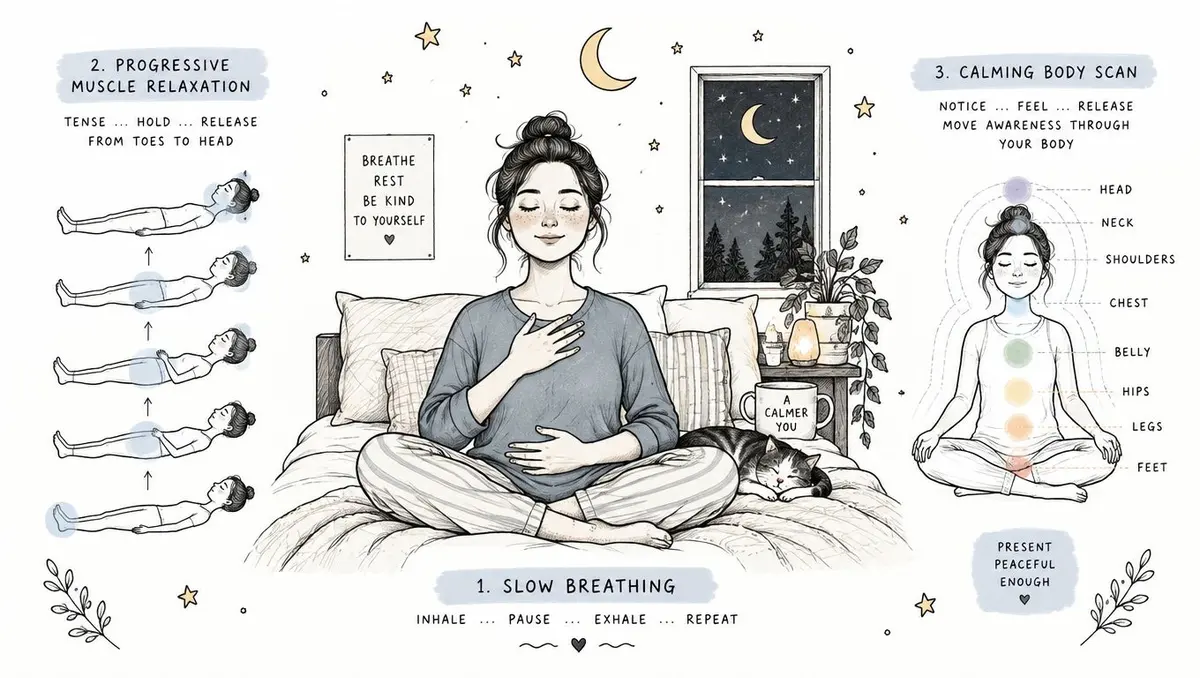
Lie down or sit with your back supported. Breathe in gently for 4 counts, hold your breath for 7 counts, then breathe out slowly for 8 counts. Repeat a few cycles, without forcing or trying to fill your lungs completely.
This method is particularly suitable when your heart speeds up or your thoughts follow one another rapidly. If holding your breath becomes uncomfortable, reduce the amplitude and keep the out-breath longer than the in-breath. The positive sign is not necessarily falling asleep immediately, but more regular breathing, a less clenched jaw and a reduction in mental urgency.
Cardiac coherence
Cardiac coherence offers a shorter alternative when you lack the energy to follow a complex method. For 5 minutes, breathe regularly, with a calm in-breath and an out-breath of comparable length. You can use a discreet timer or a breathing app, provided the screen does not draw you back into a stimulating activity.
It can be practised before bedtime or when you wake in the night. Assess it over several evenings, looking at whether the tension falls more easily. Breathing does not treat sleep apnoea, persistent pain or a medical cause, but it can help interrupt an anxious escalation.
Progressive muscle relaxation
Gently tense your feet for a few seconds, then release. Move up to the calves, thighs, abdomen, hands, shoulders, jaw and forehead. The contrast between deliberate tension and release helps you identify the areas that remain tense without your being aware of it.
Never tense a painful area. The sequence should remain comfortable and slow, without turning bedtime into a demanding workout. For a guided approach to managing stress, fatigue and anxiety, you can read this presentation of a natural solution for regaining calm.
Photobiomodulation and auricular reflexology for sleep
Photobiomodulation inspired by auricular reflexology is one of the medication-free support options. The principle consists of applying low-intensity laser light to specific points on the outer ear, within a personalised protocol. The approach is presented as gentle, needle-free and medication-free, with the aim of supporting relaxation and the regulation of behaviours linked to stress and sleep.
Cautious wording must be maintained. This method should not be described as a guarantee of a cure, nor as a substitute for a diagnosis. Its potential value lies within an overall journey, with consistent sleep hygiene, attention to the person’s profile and monitoring of how the symptoms develop.
An option to place within the hierarchy
For a person whose insomnia is clearly linked to poor evening organisation, photobiomodulation does not replace correcting habits. For a person who has already tried to structure their sleep and is looking for outside support in dealing with stress, it can be considered among other solutions. The practitioner must then gather information on schedules, night-time waking, anxiety, consumption and any treatments.
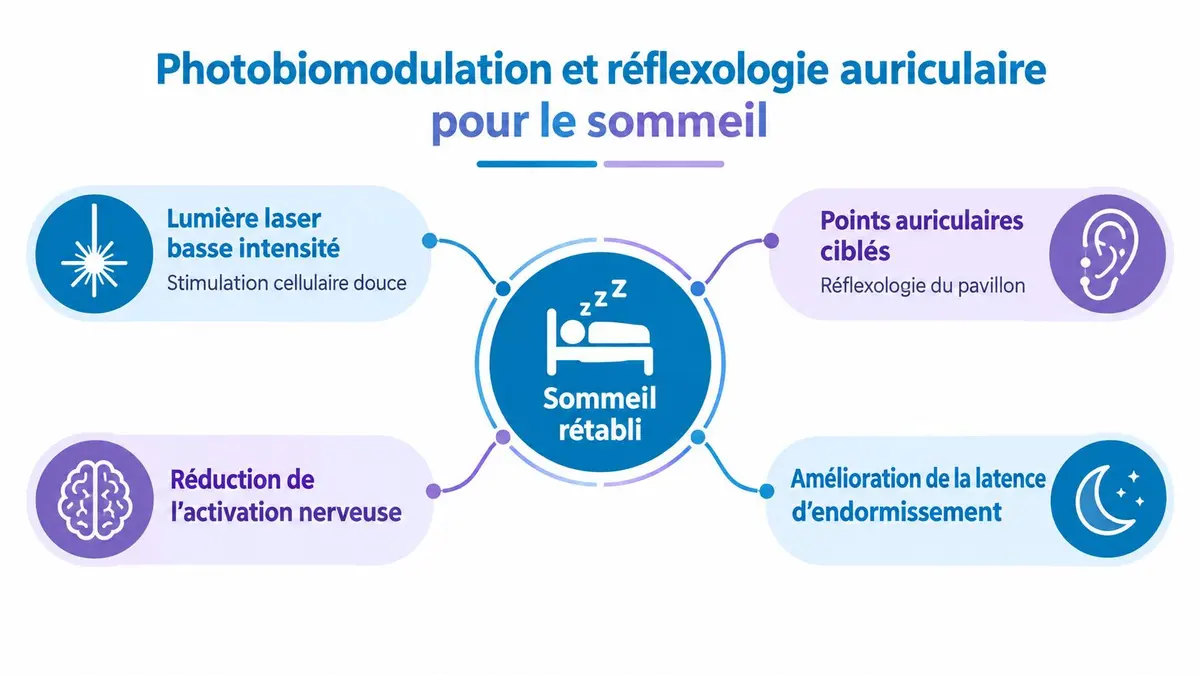
In a specialised centre, the setting remains non-medical and the session takes place by appointment. The absence of needles may suit people who do not wish to use acupuncture, while personalisation makes it possible not to treat evening anxiety, night-time waking or sleep disrupted by withdrawal in the same way.
How gentle auricular laser works should be explained clearly before any session, in particular its limits and the place it occupies in the support. A serious approach does not promise a perfect night in the short term. Rather, it helps the person choose a suitable level of support and maintain useful changes over time.
When to move from self-help to professional support
After several weeks of effort, you go to bed at a regular time, limit screens and practise relaxation, but you still lie awake for a long time or wake up every night. This situation indicates that the strategy needs to be reassessed, rather than multiplying tips.
The choice depends on the insomnia profile:
- Difficulty falling asleep: continue with self-help if the problem remains occasional, linked to an identifiable trigger and responsive to an evening routine. If anticipation of the night increases or if bedtime becomes a source of apprehension, outside support can help break this cycle.
- Night-time waking or early waking: first check the factors that keep the problem going. Systematic waking despite a protocol applied regularly justifies professional advice, especially if fatigue disrupts your day.
- Evening anxiety: breathing and relaxation exercises are useful, but their effect requires repetition. Anxiety that extends well beyond bedtime, is accompanied by a depressed mood or becomes difficult to control should be assessed by a health professional.
Seek medical advice quickly in case of heavy snoring, observed pauses in breathing, marked drowsiness or night-time pain. Problematic use of alcohol, cannabis, medication or other substances also requires suitable support. Withdrawal should not be prepared alone.
Making the right choice at the right time
The duration of symptoms is not enough to decide. Recent insomnia can already affect concentration, mood and relationships. Conversely, a long-standing problem may be trivialised because the person has learned to function despite insufficient recovery.
Natural approaches can complement medical care, support changes in habits or offer a framework for relaxation. They should not, however, delay the assessment of a worrying symptom. For a person who would like non-medical support focused on stress and sleep, the terms of the gentle auricular laser programme are detailed in this presentation of the number of sessions envisaged.
Before an appointment, note down for a few days your bedtimes, periods of wakefulness, night-time waking and how you feel the next day. This record helps distinguish difficulty falling asleep, night-time waking or evening anxiety, and then choose proportionate support.
In Strasbourg, ABC LASER offers non-medical support through gentle laser stimulation inspired by auricular reflexology, focused on stress, anxiety and sleep problems. Find out about the approach and contact ABC LASER to arrange an appointment.