
At a time when stress is everywhere, there are discreet and effective ways to regain your composure. Auriculotherapy, relying on precise points of the outer ear, offers gentle stimulation that can promote the balance of the autonomic nervous system, encourage relaxation and support better quality recovery. A well-targeted gesture helps release pressure, regulate breathing and restore inner calm, without resorting to medication. Our approach favours non-invasive techniques, including laser stimulation, for gradual calming that respects your pace.
In this article, we guide you step by step to understand where the anti-stress point is located, how it works (particularly via the vagus nerve) and how to integrate it safely into your well-being routine. Our intention is to offer you clear and reliable guidance, so that you can take care of yourself with peace of mind and regain lasting comfort in everyday life.
What is the anti-stress ear point in auriculotherapy
Located in the upper part of the outer ear, the anti-stress ear point — often associated with the “Shen Men” area — is considered a real crossroads of calm. By stimulating it with care, we seek to support a calmer response from the nervous system, release tension and promote a feeling of inner lightness. Without replacing medical advice, this marker is a simple tool to integrate into your well-being habits.
How to recognise it
- Slight sensitivity to pressure, without real pain.
- Breathing that becomes more regular after a few seconds.
- A feeling of gentle warmth or relaxation radiating towards the jaw, the neck or the shoulders.
- Gradual mental calming, as if the flow of thoughts were slowing down.
- Improved body awareness (shoulders dropping, forehead relaxing).
Depending on needs, stimulation can be done by light circular stroking, static pressure for a few breaths, or by a non-invasive method such as laser stimulation, for precise and comfortable action. We always take care to remain gentle: if the ear becomes too sensitive, lighten the touch or take a break.
Useful guidance
| Area of the ear | Main benefit | Common sensation | Stimulation advice |
|---|---|---|---|
| Anti-stress point (Shen Men) | Overall calming, modulation of stress | Moderate sensitivity, diffuse relaxation | Light pressure 30–60 s, slow breathing; possible laser stimulation in the practice |
| Autonomic nervous system point | Release nervous load, promote balance | Discreet tingling, release | Circular stroking 3 times; repeat according to comfort |
| Vagus nerve area (concha) | Support the parasympathetic response, calm the rhythm | Gentle warmth, breath lengthening | Very delicate contact; avoid insisting if the ear reacts strongly |
By precisely targeting this anti-stress ear point and its complementary areas, we help you create a soothing ritual that respects your sensitivity and is easy to repeat every day.
Precise location and self-stimulation method
Locating it with certainty
To locate the anti-stress point precisely, place your finger on the upper third of the ear then slide it inwards, to the small triangle-shaped hollow between the two ridges of the antihelix. By moving slightly towards the outer corner of this hollow, you will often feel a more reactive area, like a tiny, supple “knot”. We recommend testing micro-movements of a millimetre at a time, on both sides, in order to identify the spot where pressure triggers the most pleasant and relaxed response. The right spot is recognised less by pain than by the feeling of release that travels down towards the jaw and shoulders.
Self-stimulation technique
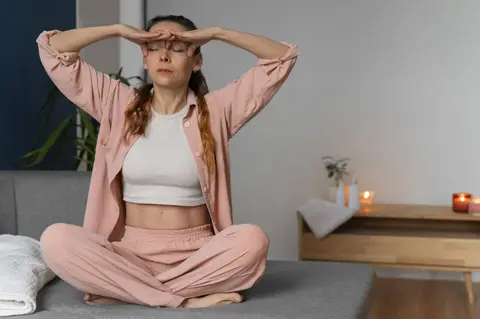
Sit comfortably, with your back supported and shoulders relaxed. With the clean pad of your index finger (or a cotton bud), make gentle contact, then slightly increase the pressure as you breathe out, as if you were guiding the breath downwards. Stay on the point for a few breaths, without forcing, then release gradually. Start again after a short pause, giving the warmth time to spread and the breathing time to lengthen by itself. A drop of neutral oil can improve comfort if the skin is dry; avoid any pressure with the fingernail and avoid pierced or irritated areas.
In practice, we suggest using this technique briefly in the morning to calm the system before the day, and in the evening to help the transition to rest. Before a demanding situation, a few breaths focused on this point prepare the emotional ground without overstimulating you. If any discomfort appears (dizziness, sharp pain, persistent redness), lighten the touch immediately or stop, then start again later with less intensity. For more precise support, professional stimulation, particularly with targeted light, can complement your routine in a gentle and personalised way.
Expected benefits, duration and frequency of use
Effects felt day to day
By targeting this point regularly, you may notice an overall release, as if the body were gaining inner suppleness. Breathing returns to a fuller rhythm, the shoulders drop, the jaw loosens and the mind clears. This modulation of nervous tone often promotes falling asleep more easily and waking up more rested. We also observe, in many people, a better ability to cope with the unexpected without overreacting, with a quicker and more stable return to calm.
Over the days, the effect builds up little by little. The nervous system gets used to this “invitation” to let go, and you become more independent in managing the intensity of your day. Without forcing anything, this ritual nurtures a form of inner continuity: less scattering, more presence, and a feeling of coherence between breath, posture and state of mind.
Duration and frequency of use
Favour brief, quality sequences. A few focused breaths are enough most of the time; you can continue a little longer if relaxation sets in, always staying below the threshold of discomfort. We recommend spreading these moments of care throughout the day: before an important appointment, after a busy period, or as a prelude to bedtime. In the morning, a short stimulation lays a foundation of active calm; in the evening, it eases the transition to the night.
Adjust according to your sensitivity: if the ear becomes reactive, space the sessions out more and lighten the contact. If there is local skin irritation, a recent piercing or if you wear a hearing aid, avoid the area and wait until the skin has fully recovered before starting again. If you have a particular condition or any doubt, ask a professional for advice. For finer guidance, light stimulation carried out in the practice can complement your routine with precision and gentleness, without disrupting your natural rhythm.
Precautions, contraindications and warning signs
Because it involves a sensitive and richly innervated area, this practice benefits from a few common-sense guidelines. We always favour a gradual approach: clean, light, short contact, with close attention to how you feel. If release does not set in or if discomfort appears, it is better to lighten the touch immediately and postpone the stimulation.
Essential precautions
Make sure your hands are clean and your skin healthy before any contact. Avoid heavy pressure and pointed objects; the pad of the finger or a soft cotton bud is quite enough. If necessary, remove ear jewellery and avoid areas that have been recently pierced, are irritated or still scarring over. Sit down to prevent any passing dizziness, and limit yourself to short, spaced-out sequences, particularly if you are new to this practice or if your skin is reactive.
Contraindications and warning signs
In the event of an infection of the ear or the ear canal, a wound, a burn, weeping skin disease, or following recent surgery in the area, refrain and wait until it has fully resolved. If you have known photosensitivity, a history of epilepsy, or if you are taking a treatment that weakens the skin, light stimulation should be considered with caution and prior advice. During pregnancy, we recommend a very gentle and occasional approach. If you wear a hearing aid, avoid any pressure on the contact points and concentrate on the uncovered areas. Stop immediately in the event of sharp pain that persists after stopping, marked dizziness, sudden ringing in the ears, bleeding, warm redness that does not fade, prolonged numbness, palpitations or a feeling of increasing anxiety.
If any doubt remains, it is better to pause and seek advice before starting again. This approach remains a well-being complement: it does not replace a diagnosis or medical follow-up, particularly in the case of intense stress, recurrent insomnia or ear, nose and throat symptoms. We remain available to adapt the stimulation, including light stimulation, delicately and in complete safety, so as to respect your pace and your comfort.
In conclusion, integrating this auricular marker into your routine means making a simple gesture each day that brings smoother breathing, a clearer mind and a more stable presence. We are by your side to turn this attention into an effective ritual, with gentle, non-invasive techniques adjusted to your sensitivity. If you would like to go further, we invite you to move from reading to experience: at ABC Laser, we co-create a precise pathway with you, respecting your pace, in order to promote lasting calm without rushing your body. This approach complements your usual care and can become reliable support in the demanding moments of everyday life. Ready to take the first step towards greater serenity? Contact us today for personalised support and book your appointment: we will take the time to listen to your needs, refine the guidance and guide you with rigour, kindness and discretion.