After a laser session to reduce sugar dependence, you have already come a long way. Your brain is starting to lose the habit of sugar spikes, but industrial products are still designed to reawaken these cravings. Hidden sugars in everyday foods are everywhere, including in products that you do not perceive as sweet.
In this guide, we offer you a simple method for decoding labels and choosing products that respect the work already done. The idea is to help you stay in control when you go shopping, without frustration, and while learning to naturally include less sugar in your daily diet.
The World Health Organization recommends a maximum of 50 g of sugars per day, whereas average consumption often exceeds 100 g because of the additions concealed in processed products. By learning to spot these hidden sugars, you protect your results after your session and prepare for lasting change.
The practical guide to identifying and tracking down hidden sugars in everyday foods (labels)
Reading time: ~9 min
Contents
- Why hidden sugars in food keep dependence going
- Learning to read the ingredients list
- Decoding the nutrition table in 10 seconds
- Not getting caught out by marketing claims
- Top 10 foods where hidden sugars sneak in
- Tips for doing your shopping without reigniting sugar cravings
- Mini FAQ on hidden sugars and sugar withdrawal
Why hidden sugars in food keep dependence going
Hidden sugars are sugars added by manufacturers to foods that are not necessarily perceived as sweet: sliced bread, ready meals, sauces, cold meats, tinned vegetables, fruit yoghurts, certain cereals and even plant-based drinks.
They improve texture, shelf life and taste. The problem: your brain nevertheless receives a regular sweet signal that keeps the reward circuits going and can reactivate strong cravings, even after work on dependence.
It is estimated that around 80% of industrial products contain added sugars. Without vigilance, it is very easy to exceed the recommended 50 g in a single day, which can disrupt the rebalancing begun after a laser session.
Learning to read the ingredients list
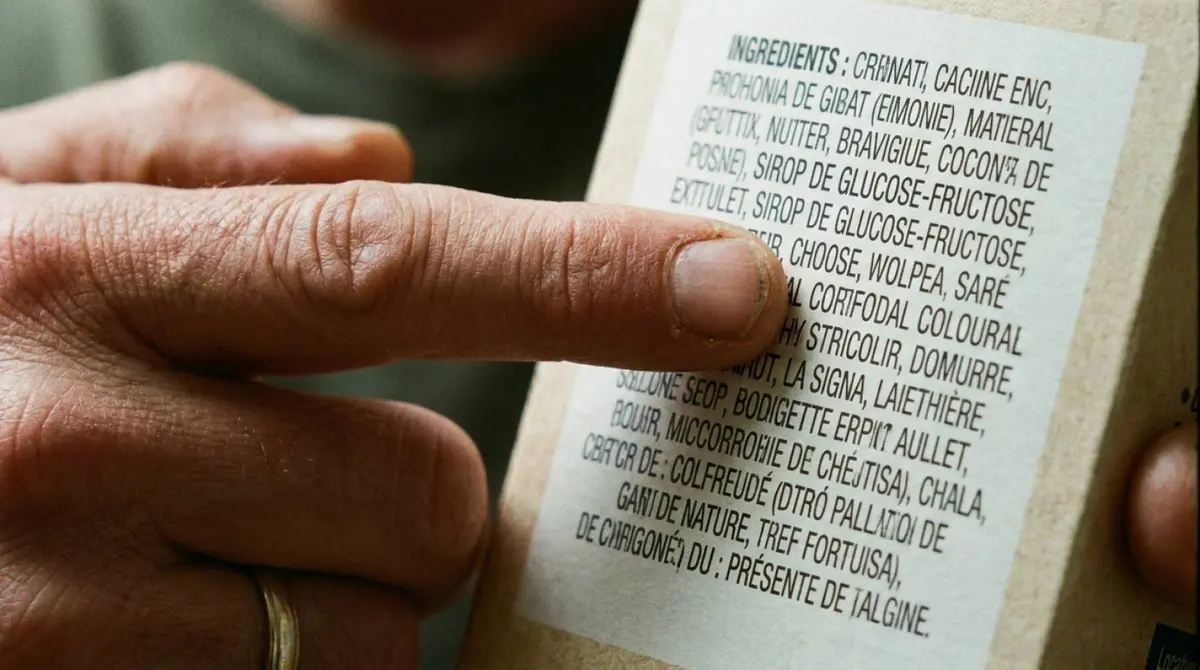
The first thing to look at is not the nutrition table, but the ingredients list, which is always ranked in descending order of quantity.
A simple rule
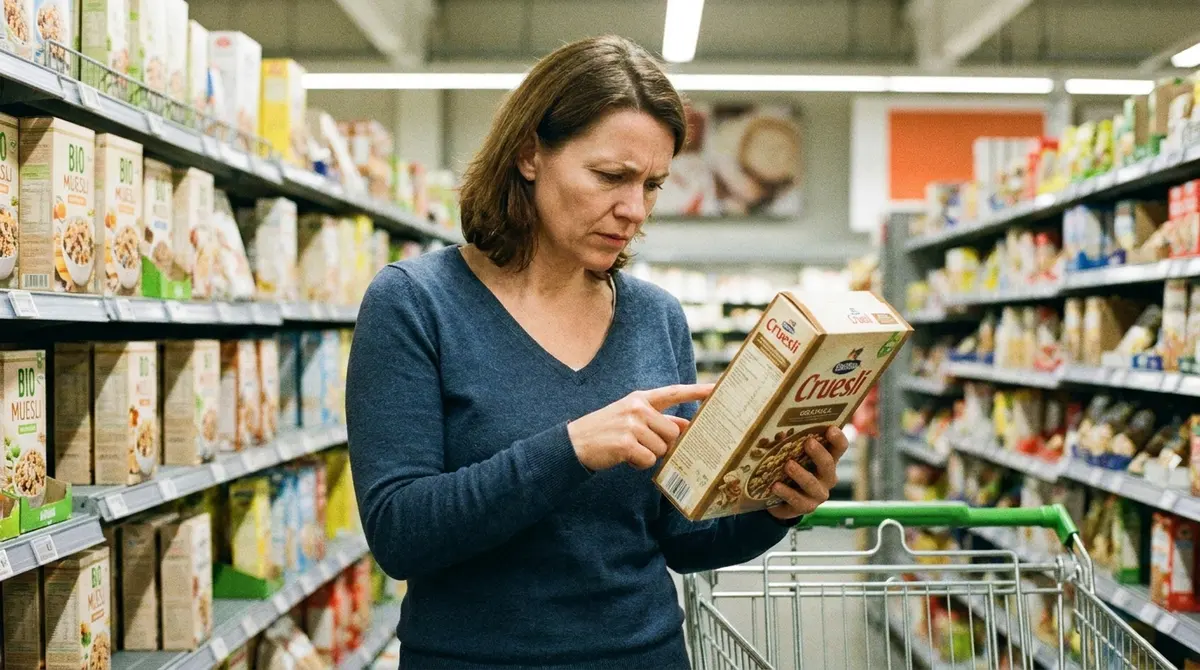
If a sugar appears in the first three ingredients, the product is very high in added sugars; it is better to put it back or to eat it only rarely.
Sugars hide behind many names
Common clues: terms ending in -ose (glucose, fructose, sucrose, lactose, dextrose, maltose); expressions containing “syrup” (glucose-fructose syrup, corn syrup, malt syrup); words such as maltodextrin, invert sugar, fruit juice concentrate.
A simple tip for your shopping
Take ten seconds: read the top half of the list. If two or three sources of sugar appear in the first five ingredients, avoid it for everyday use.
Common examples
Sliced bread and rusks containing dextrose or glucose syrup; prepared sauces with glucose-fructose syrup; fruit yoghurts where sugar comes immediately after milk.
Decoding the nutrition table in 10 seconds
After the ingredients list, always compare the values per 100 g or 100 ml. The key line is “carbohydrates of which sugars”, which combines natural and added sugars.
For most solid foods, a product is considered low in sugar below about 5 g/100 g; for breakfast cereals, a threshold of up to 8 g/100 g remains reasonable if they are high in fibre.
Example: a plain yoghurt contains ~5 g/100 g (natural lactose). A fruit yoghurt can go up to 15 g/100 g, including 10 g of added sugars.
Also look at the energy (kcal), saturated fat and salt. The Nutri-Score can help, particularly for dairy products and cereals.
Not getting caught out by marketing claims
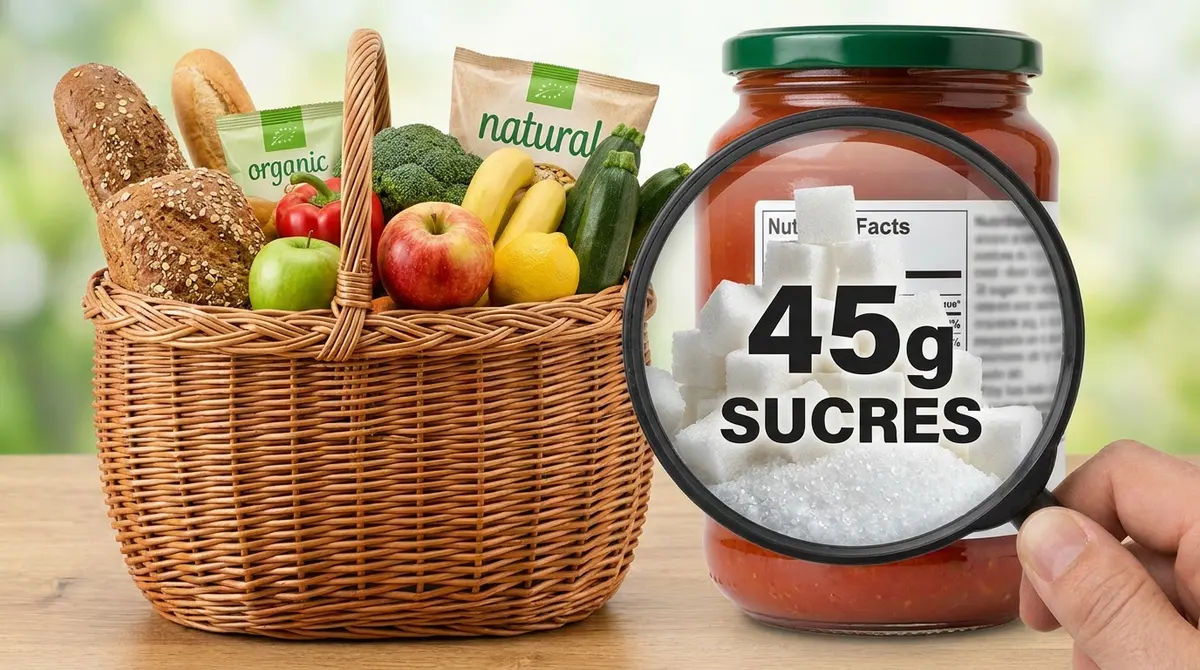
Sugar-free: ≤ 0.5 g/100 g or 100 ml. No added sugars: no added sugar; only naturally occurring sugars are permitted and the packaging must state “contains naturally occurring sugars”. Reduced sugar: a reduction of ≥ 30% compared with the standard version.
The claim “sans sucre” (in the singular) can mask the use of other sugars such as fructose. Many reduced-fat products compensate for the loss of taste with more sugar; hence the importance of reading labels.
Top 10 foods where hidden sugars sneak in
- Sliced bread and rusks (sugar or dextrose for browning/softening)
- Savoury ready meals (sugar to balance the flavour)
- Ready-to-use sauces and industrial salad dressings
- Tinned vegetables sweetened to soften them
- Cold meats (sugar for colour and texture)
- Fruit yoghurts, dessert creams, flans
- Breakfast cereals, even “fitness” or “vitality” ones
- Reduced-fat products with added sugar
- Savoury aperitif biscuits containing sugars or maltodextrins
- Sweetened or flavoured plant-based drinks
Tips for doing your shopping without reigniting sugar cravings
Choose foods that are as unprocessed as possible
Opt for fresh or plain frozen vegetables, pulses with nothing added, unsweetened nuts and plain yoghurts. For a sweet touch, rely on fresh fruit, cinnamon or vanilla.
Cook at home whenever possible
Home-made tomato sauce, salad dressing or soup rarely contain added sugar unless you add it yourself; the ingredients list remains short and familiar.
Use apps as a back-up
Scanning apps help to compare two products, but keep your own reference points: the ingredients list, the “carbohydrates of which sugars” line, the amount per 100 g.
Adopt the ten-second reflex
Before putting an item in your basket: 1) check whether a sugar is among the first three ingredients; 2) look at the sugar content per 100 g. If the product greatly exceeds the thresholds and contains several sugars, keep it for genuinely special occasions.
Link your choices to your underlying goal
Every label you read consolidates your withdrawal from sugar. To go further, you can free yourself from your sugar dependence with natural laser support.
Reminder: ABC Laser’s services fall within wellbeing, do not constitute a medical procedure and do not replace the advice of a health professional. For more information, discover our solutions.
Mini FAQ on hidden sugars and sugar withdrawal
Is a product with no added sugars always risk-free?
Not necessarily. It may be naturally very sugary (fruit juices, concentrated fruit purées). Always check the sugars per 100 g and how often you consume it.
Can I still eat sugary products after a laser session?
Yes, but during the stabilisation phase, strictly limit fast-acting sugars and ultra-processed products. A whole piece of fruit or a home-made dessert low in sugar, eaten occasionally, will be better tolerated than repeated snacking.
Do the natural sugars in fruit pose the same problem?
Fruit contains fructose, fibre, water and micronutrients that slow down absorption and increase satiety. The main problem comes above all from the accumulation of added sugars in processed products.
How can I include less sugar without frustration?
Start by changing your environment: fewer sugary products at home, more unprocessed foods. Rely on spices, herbs, citrus fruits, crunchy or creamy textures; your taste buds get used to less sweet flavours again and the feeling of deprivation diminishes.
By learning to spot hidden sugars, you turn every trip to the supermarket into a concrete step in your withdrawal from sugar. If needed, also explore our approach to regulating sugar consumption with laser.

Conclusion: staying in control of hidden sugars day to day
Identifying hidden sugars in food through ingredients lists, nutrition tables and a critical eye on marketing allows you to secure the effects of your laser session. You thereby reduce blood sugar spikes, compulsive cravings and the risk of falling back into old reflexes.
By combining unprocessed products, home cooking and the ten-second label-reading reflex, every shopping trip becomes a concrete action in favour of your withdrawal from sugar. Over time, your tastes adjust and a less sugary diet naturally becomes part of your daily life.